Appearance
Extensions
Extensions add new actions to PopClip. You can install ready-made extensions and also create your own.
Extensions and Actions — what's the difference?
The two terms are related but distinct:
- An action is a button that appears in the PopClip bar. Actions are what you see, use, and arrange in the Actions tab.
- An extension is a package that provides an action. Extensions are what you install, update and remove.
When you install an extension, an action for it is added to the actions list. But a single extension can provide multiple instances of its action, each with its own name, icon, settings and position in the bar. For example, you could set up one translation extension as two actions, each translating to a different language. To create another instance of an action, use the Duplicate command — see Organizing Actions.
PopClip's built-in actions work the same way: they are provided by built-in extensions that come with the app.
Deleting all of an extension's actions from the actions list also uninstalls the extension itself. The exception is built-in extensions, which are never uninstalled — a deleted built-in action can be restored from the Manage Extensions sheet at any time.
Get stuck in!
Browse the PopClip Extensions Directory which currently contains 285 extensions.
Installing a downloadable extension
When you download a ready-made extension it will have the file extension .popclipextz or .popcliptxt. Simply open the file to add the extension to PopClip.
Unsigned Extensions
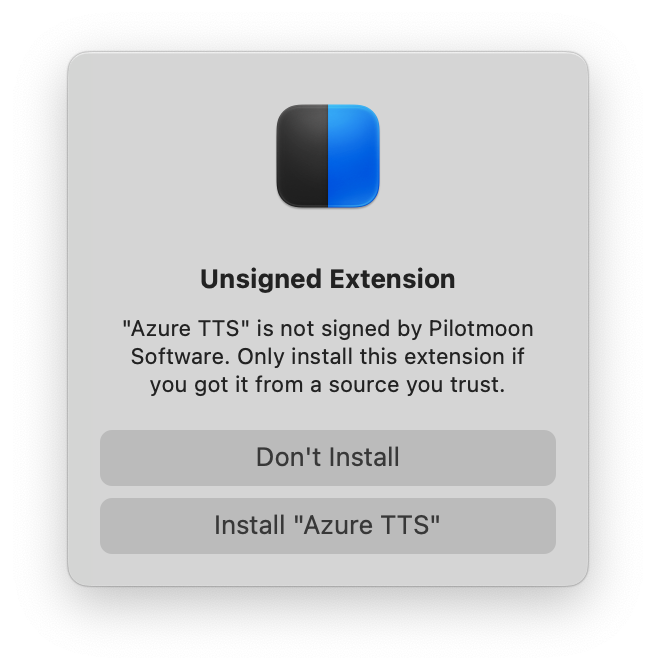
If you see an "Unsigned Extension" warning it means the extension runs code that has the potential to access files on your machine or access the internet, and is not from PopClip's developer. You will need to confirm whether you want to install the extension.
WARNING
Beware of extensions from untrusted sources as they can potentially be malicious.
Installing a snippet
PopClip can load extensions directly from a special plain text format called a "snippet". Snippets are useful for creating quick extensions and sharing them as plain text, without having to create a file. Snippets can be shared in emails, forums, on websites — anywhere you put plain text.
Here is an example snippet, which defines an action for searching Emojipedia for the selected text:
text
#popclip extension to search Emojipedia
name: Emojipedia
icon: search filled E
url: https://emojipedia.org/search/?q=***
To install that, you select the text and then click the action Install Extension "Emojipedia" that appears in the PopClip bar.
Snippet format
Notice that the first line of the snippet starts with #popclip. This is a special marker that tells PopClip that this is a snippet. For more about snippets, see Snippets in the developer docs.
Managing installed extensions
To see a plain list of every installed extension, open the Manage Extensions sheet: click the Tools menu at the bottom of the Actions tab and choose Manage Extensions… (shortcut: ⌘E).
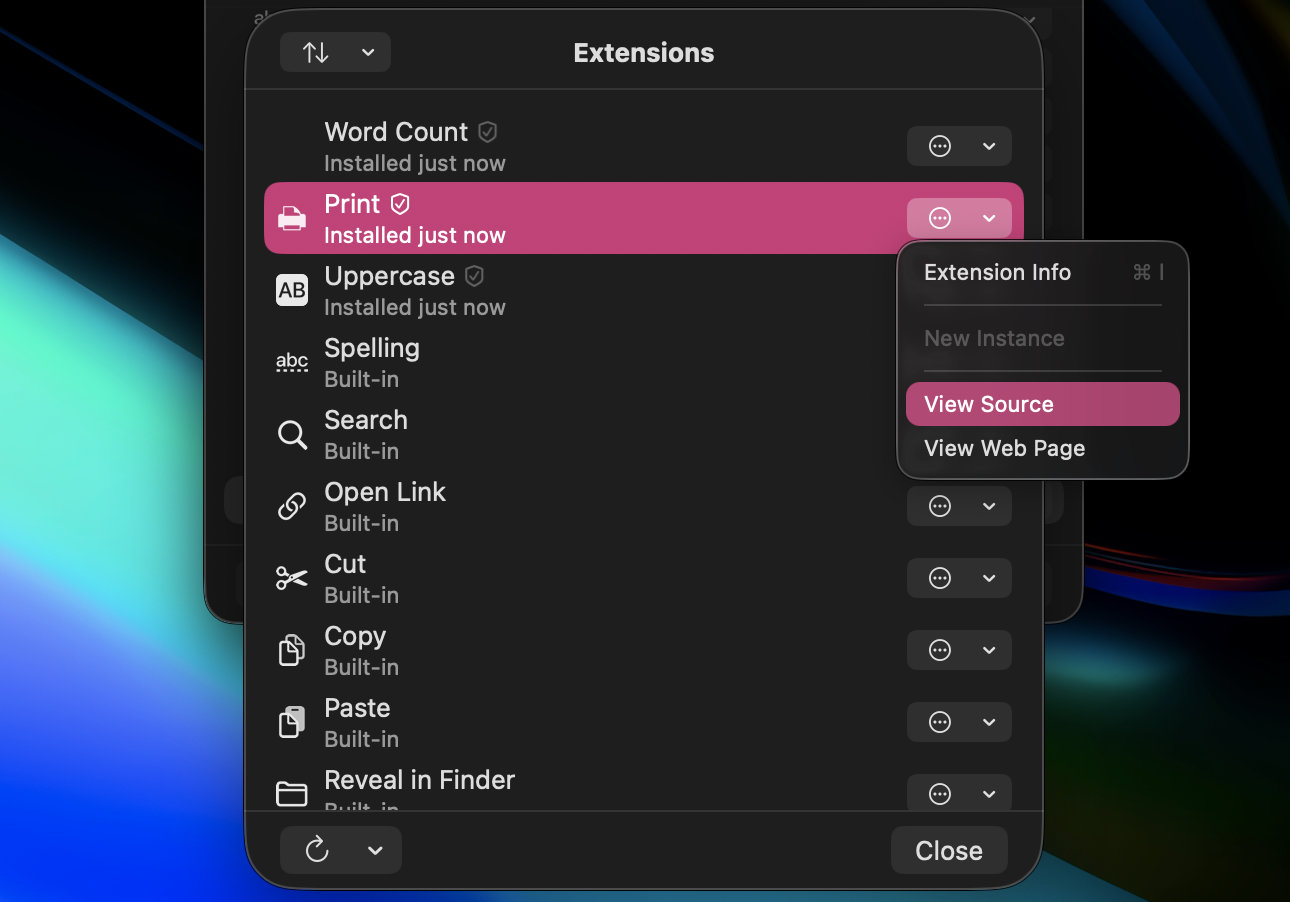
The list can be sorted by name or by install date. From each extension's commands menu you can:
- view Extension Info;
- create a New Instance of the extension's action in the PopClip bar;
- use View Source to inspect the extension's source code;
- use View Web Page to visit the extensions directory page on the web.
Extension updates
Extensions installed from the PopClip Extensions Directory can update to new versions automatically. Use the Updates menu in the Manage Extensions sheet to check for updates, and to turn Update automatically on or off.
Extension Info
To see information about an extension, choose Extension Info from the extension's commands menu.
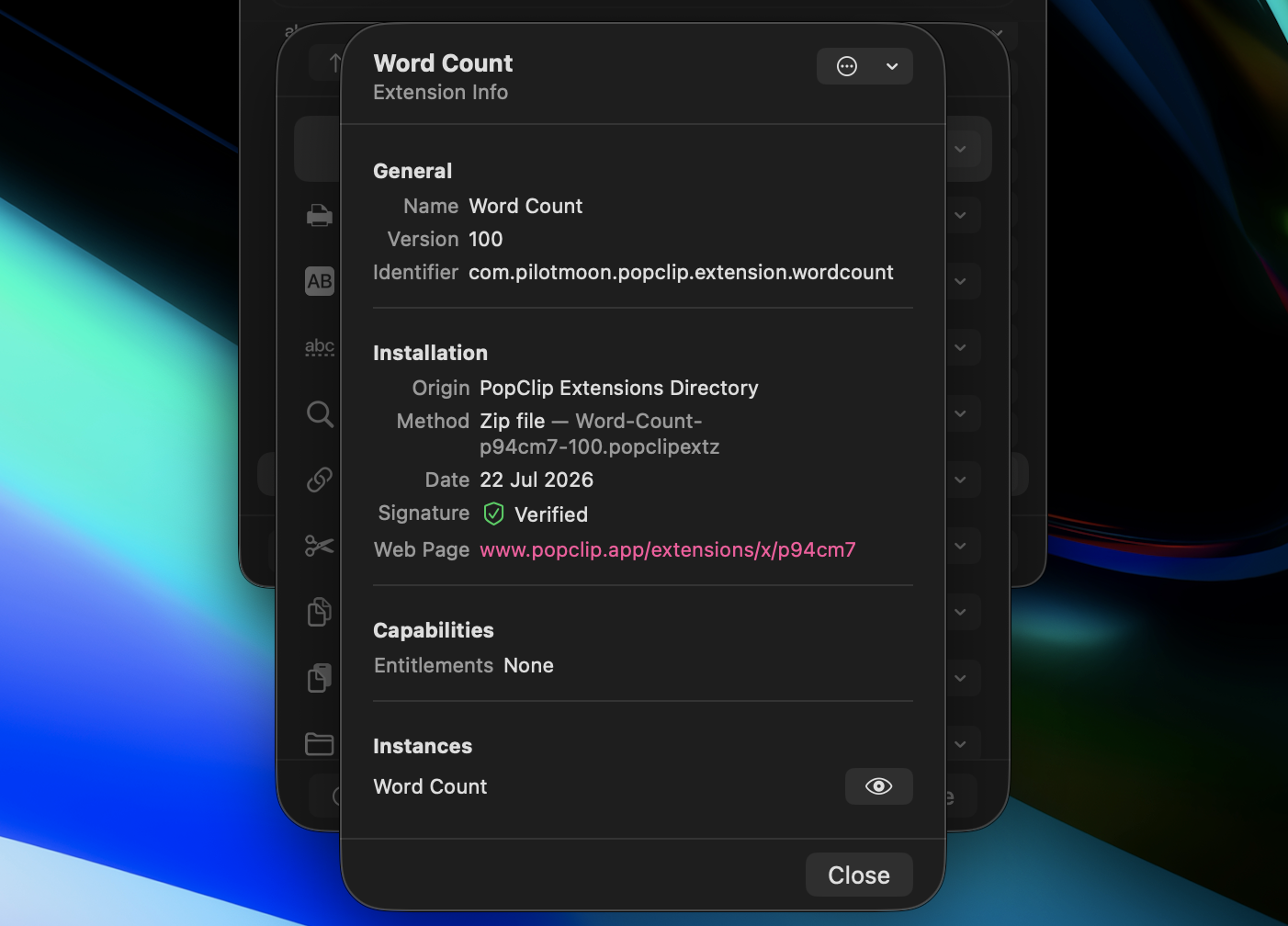
The info sheet shows the extension's origin (for example, the Extensions Directory, or a snippet), its version, when and how it was installed, and its signature status.
View Source
The View Source command Reveals a folder in Finder containing a copy of this extension source files.
PopClip will not see any changes you make in this folder and it will revert any edits you do make. If you want to edit the files to make a custom extension, copy the folder elsewhere and rename it with a .popclipext suffix. Then double click that folder to install it as a new extension.
Creating your own extension
For more about creating both snippets and downloadable extensions, see Developer Docs.